Saturday, July 31, 2010
Olive-sided Flycatcher!
I was leading some bird walks at Carpenter Lake this afternoon with Jim Bull and Leonard Weber for the Detroit Audubon Society. We were doing the walks for some City of Southfield program so most of the people had never been bird watching before. We weren't expecting to see anything unusual but it was fun to see the people getting excited about the Blue Herons, Cormorants, Indigo Buntings and Cardinals. I think its good to be reminded sometimes about how cool even our common birds are. On the last walk I noticed a flycatcher sitting in a dead tree across from the dam. When I saw the olive sides I immediately thought of an Olive-sided Flycatcher. My next thought however was that an Olive-sided Flycatcher would never be in southeast Michigan in July. I soon confirmed the ID, however, when it turned around and I could see the white spots on its back. It was lifer #342 for me, #254 for the state and #197 for Oakland County. Checking in my Birders Guide to Michigan, I realized that it really isn't extremely unusual as Olive-sided Flycatcher is listed as rare starting in August and today is the last day of July. I was pretty excited to see a lifer on a day when I had absolutely no expectations of seeing one.

Saturday, July 3, 2010
Colorado Trip (Days 5-8)
In the morning Dad and I went to Mancos State Park to look for Grace's Warblers. We heard several and after a bit of searching I was able to locate one at the top of a Ponderosa Pine. Its bright yellow throat and eyebrows really stood out. This was lifer 335 for me. A little bit later we heard and then saw a Western Wood-pewee (lifer 336). There is some great Ponderosa Pine habitat at this park.
 On the way back to Mancos I was surprised to find a Bufflehead in a small pond; while they do nest in the Rockies further north this was quite far south for one in the summer. We spent most of the day at Mesa Verde but on the way there we stopped by the Sleeping Ute Rest Area because Riley Morris, a local birder, had told me that Pinyon Jays were often found at the feeders there. Just a minute or so after we got there two Pinyon Jays (lifer 337) landed in the tree where the feeders were. They only stayed for less than a minute, but I was able to get a picture of one.
  I also got a nice shot of a Western Kingbird there.
  At Mesa Verde I saw most of the same birds as the day before, the one exception was a Gray Flycatcher (lifer 328) in the Pinyon-Juniper across from the Cliff Palace. It seemed kind of odd to watch the Juniper Titmice and Spotted Towhees looking for food in the parking lots and under the picnic tables, I know I've never seen an Eastern Towhee doing this.
  I also found another lizard, I think this is a Sagebrush Lizard.
  Back at the Bed and Breakfast, I took several pictures of the Black-chinned hummingbirds, the females were much more cooperative than the male.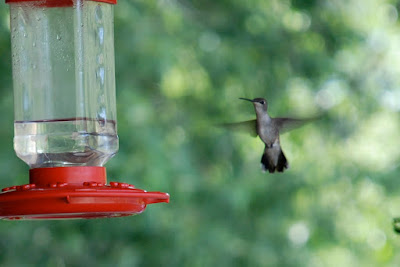

 I also saw this beautiful male Rufous Hummingbird.
  After dinner Mom took me to Cottonwood Park in Mancos. I had found out on one of the Colorado birding websites that Lewis's Woodpeckers could usually be found there. On the way we found a Say's Phoebe (lifer 339) on a fence. I tried taking a few pictures but he was in rather bad lighting. No sooner had I complained about this than he flew to a much better lit perch. His beak was still casting a shadow over his face, though, so I asked him to move it. After a minute he moved his bill and I was able to get a nice picture, I wish all birds were as cooperative.
  After I got to the park, I soon saw a large dark woodpecker fly into a nearby tree. It turned out to be a Lewis's Woodpecker (lifer 340).
  Unfortunately the sun was already setting and I wasn't able to get any good pictures. I also found a Western Wood-pewee on her nest. It was a nice way to end the day.
Wednesday didn't go too well. After we had passed Pagosa Springs, we realized we were almost out of gas and we had to buy gas from someone to get back to Pagosa Springs where we were able to get more gas. Then Mom got pulled over for speeding. After this I decided to stop by Alamosa instead of Monte Vista NWR because Sage Sparrow was possible at Alamosa, big mistake. Alamosa was really quiet except for several Sage Thrashers. I did see one lifer when a small flock of Band-tailed pigeons flew over the highway. On Thursday we went to Cherry Creek State Park before we went to see the King Tut exhibit in Denver. I saw a Yellow-breasted Chat and Black-chinned hummingbird along the trails.

In a small pond I found three Snowy Egrets and I also saw two American White Pelicans fly over. As we were driving into Denver I was surprised to see four more White Pelicans fly over.
Yesterday we flew back home. We flew in over Oakland county and it was neat to see some of the places I bird at like the American Center Marsh from the air. It was quite a successful trip for me with twenty-six lifers to bring my life list to 341 and 90 species on the trip. As with all trips, I missed a few birds I thought I would easily find at Mesa Verde like Bushtit and Ash-throated Flycatcher, but I also saw a few birds, like Prairie Falcon, that I was not expecting to see.
Colorado Trip (Day 4)
After spending the night in Montrose we headed south for Mesa Verde. Our first stop was Ouray where we went to Box Canyon Falls park to look for Black Swifts. I saw White-throated Swifts flying high above and an American Dipper. These were lifers 326 and 327. A Violet-green Swallow landed on a nearby rock, creating an excellent photo opportunity.
 I was unable to find the Black Swift nest that was supposed to be visible from the metal walkway that went back into the crevice where the falls were. As I was about to give up, however, I finally spotted a Black Swift flying in the crevice and it disappeared behind the falls; it was lifer 328. There were also several Golden-mantled Ground Squirrels under the feeders.
 After a stop in Durango for lunch we went to the Rafter J subdivision west of Durango. This subdivision is home to the only colony of Acorn Woodpeckers in Colorado. I found three Acorn Woodpeckers in the large, dead Ponderosa Pine as well as a Western Bluebird; these were lifers 329 and 330.
  Next we stopped at the place we were staying, the Riversbend Bed and Breakfast. They have a really nice place and a cabin as well, which we stayed in. They had three hummingbird feeders where I saw several Black-chinned Hummingbirds (lifer 331). They also had thistle feeders with Cassin's Finch, American Goldfinch, Pine Siskin, and Lesser Goldfinch.
 We packed a dinner and headed to Mesa Verde National Park to spend the evening. At the Far View Visitor I saw an adult Green-tailed Towhee (lifer 332) being followed around by two begging juveniles. At the Spruce Tree House I saw and heard a Plumbeous Vireo (lifer 333), many Black-throated Gray Warblers and several Lesser Goldfinches.
 After checking out the cliff dwelling we went to a picnic area across the road. It was in the middle of a Pinyon Juniper forest and almost immediately we saw several Juniper Titmice (lifer 335).
 There were also Mountain Chickadees, Mountain Bluebirds, Black-throated Gray Warblers and a Plumbous Vireo.
 I also found a small lizard that I haven't identified yet.
 This was the most successful day of my trip as far as the number of lifers goes with eight for the day.
Colorado Trip (Day 3)
On Sunday we spent the morning with family and then headed off for Montrose, on the west side of the Rockies, at about one. We spent most of the next seven hours driving but we made several stops along the way. Our first stop was at a Prairie Dog town along the highway where there were Gunnison Prairie Dogs.

Eventually we entered the Gunnison Valley, which is mostly full of sagebrush. We stopped at the Waunita Hot Springs Lek, which is the only public lek for Gunnison Sage Grouse in the world. Unfortunately since we were there after the season when they were displaying, and it was the middle of the afternoon, we did not see any. I did see one Sage Thrasher and several Brewer's Sparrows which were lifers 321 and 322 respectively. I also got this picture of a Mountain Bluebird.

As we were driving along Highway 50 just east of Gunnison I spotted a falcon flying beside the road. I yelled for dad to pull over and once I got out I was able to see that it was a Prairie Falcon, lifer 323.


We stopped in Gunnison for dinner and I saw several Eurasian Collared Doves in the town. They were lifer 324 for me.

Finally at about 8:00 p.m. we reached Black Canyon of the Gunnison National Park. Since it was so late the rangers let us in for free and when they heard we were looking for Dusky Grouse they told us exactly where to go. Sure enough, after we had driven just a little way along the road we saw a male Dusky Grouse displaying right by the side of the road! I took tons of pictures and here are some of them.


This was probably my favorite bird for the whole trip. Here is a shot of the sun setting over the Black Canyon of the Gunnison, to see more pictures go to my flickr page (link is on the right side of this page).

Saturday, June 26, 2010
Colorado Trip (Days 1 and 2)
I arrived at the Denver Airport at about ten a.m. and after meeting with my uncle we were looking for Burrowing Owls in about an hour on the west edge of the airport. As we were driving along the road we came across two kettles of Swainson's Hawks, I estimated about fifty. Here are a few shots.


After shooting some pictures we continued on to the spot where the Burrowing Owls were supposed to be. After a little bit of searching we spotted one when it briefly flew and landed on a Prairie Dog mound.

There were many Prairie Dogs and I managed some good shots of them thanks to the 400mm lens from my uncle.


As we were heading back to the car I spotted another Burrowing Owl sitting on the fence. It flew down after a minute to join two other burrowing owls sitting on a Prairie Dog mound! I think that this must have been a family of Burrowing Owls, this was a great lifer to start my trip. At the hotel in the evening I found several young rabbits and was able to get some good pictures of them.


Today I met Kathy Dunning, a local birder, at five-thirty this morning at Deer Creek Canyon, a park in the foothills west of Denver. I saw four lifers; Virginia's Warbler, MacGillivray's Warbler, Lesser Goldfinch, and Lazuli Bunting. Spotted Towhees were everywhere and Broad-tailed Hummingbird, Cordilleran Flycatcher, Western Scrub-Jay, and Black-headed Grosbeak were birds I saw that I don't see in the east. Here is a picture of the area.

Tomorrow I am heading for Black Canyon of the Gunnison National Park and then for Mesa Verde, I will update my blog as often as possible.
Friday, June 18, 2010
Birding the Thumb

Karl Overman and I birded the Thumb yesterday and we saw quite a few good breeding birds. We started off with stopping by the lakeside cemetery in Port Huron where a pair of Merlins has nested. We saw and heard the male Merlin before we went on. I think this might be the first time Merlins have nested in the southeastern Lower Peninsula. After a quick stop for Pine Warblers in Southern Sanilac County we continued to Minden SGA in northern Sanilac County. On the way we made several stops to check the fields. Bobolink numbers were quite good, I think there were almost as many Bobolinks as Eastern Meadowlarks. Five Brown Thrashers (one group of three and two other single birds) seemed a bit on the high side as well. Minden SGA was quite interesting, I had never seen anything like it before. Almost the whole area is part of a bog (see above picture). Because of this species that are typically found further north can be found here. Brewers Blackbirds were plentiful and I managed a few poor shots of them.

There were also several Lincoln's Sparrows.

For both of the above birds while they are quite common in and around Minden SGA, they are completely absent as breeders from the rest of the SELP. We also found a few other birds that are tough to find breeding in southeast Michigan such as Clay-colored Sparrow and Alder Flycatcher. We also found a Pink-edged Sulphur in the bog, it was a lifer for both of us. To see Karl's pictures of it click here. At the woods at the edge of the bog we heard a singing Mourning Warbler and I was finally able to see it after walking through a bunch of raspberries and getting all scratched up. Our next stop was in Huron county at Wagner County Park. We heard several more Mourning Warblers and there were lots of Northern Waterthrushes.

We were also able to find a singing Black-and-white Warbler and a singing Winter Wren south of the trail. It was upsetting to see all of the cut down trees in the park. It literally looked like they decided the forest was too thick and went through cutting every other tree down. Apparently they did this to the whole park, even when we drove a back road at the edge of the park we found trees that had been cut down. It appears that this has driven the breeding Canada Warblers out of the park. There were a few times when we thought we might hear one in the distance but we weren't sure, at any rate, the Canada warbler population has been greatly reduced. After this we headed for the town of Bad Axe and the airport there to look for Upland Sandpipers. As we were scanning the mowed grass along the runways in the hope that an Upland Sandpiper would come out of the tall grass, Karl thought he heard one on the other side of the road. We looked across the road and there, on top of a telephone poll at the edge of a cornfield, was an Upland Sandpiper (lifer #315)!

I had heard they perched on fence posts but never expected to see one thirty feet in the air on a telephone poll. After wandering around on back roads for a while, we headed down to Port Huron SGA in St. Clair County. Since it was the middle of the afternoon it was pretty quiet but we did find an Acadian Flycatcher. I was able to get a nice photo of a Viceroy there.

We ended the day with 88 species, ten species of warblers and all 8 breeding flycatchers. It was one of the best days I have had in Michigan in June and definitely the highest species total I have had in June in southeastern Michigan.
Tuesday, June 1, 2010
Oak Openings Metropark & More
Yesterday Karl Overman, Cathy Carroll, my dad, and I went down to Oak Openings Metropark west of Toledo. As we pulled up at about seven along Sager Rd. we quickly heard and then saw a Grasshopper Sparrow singing at the top of a small bush. Almost immediately after this we heard two Yellow-breasted Chats singing in the bushes. Surprisingly, one of them was actually singing about three fourths of the way up a taller tree and we were able to get some very good views of it. The chats were lifers for me (#311) so I was happy I got good looks at one. After this we headed down Girdham Road. Almost as soon as we got out of the car I heard a Prairie Warbler buzzing in the dunes just south of the Wabash-Cannonball trail. After quite a bit of searching we were finally able to see it. It was beautifully lit and allowed a fairly close approach, this was lifer #312 for me. Karl Overman was happy to see them here as well, he said he hadn't seen a Prairie Warbler at Oak Openings in about twenty years. We then hiked down the Wabash-Cannonball trail for a little ways where we saw our only Red-headed Woodpecker of the day and thought we heard a Summer Tanager. When we returned to the road we found a large Box Turtle right by the side of the road I was able to get several good pictures of this turtle which is never seen near where I live.

A bit further down the road we heard a Yellow-throated Vireo and Black billed Cuckoo and were able to see a male Summer Tanager. There were several Lark Sparrows in the field as well. Surprisingly, we also heard another Prairie Warbler. We then headed down on Jeffers Rd. toward the horse staging area. While we were still driving we heard Hooded Warbler and Acadian Flycatcher singing in the woods. As soon as we got out of the car we heard a Blue Grosbeak singing in a large Oak in the middle of the field. It took us almost fifteen minutes to actually see it, however, and when I finally spotted it it flew across the road into another tree. I was finally able to get some good looks at the bird and see its chestnut wing bars and black 'mask'. This was lifer #313 for me. After this we stopped briefly at the visitor center and the lodge but we did not find much at either spot. We then stopped at the eastern entrance to the Wabash-Cannonball trail. We added Wood Thrush to our list here and we also saw a Hackberry Butterfly. The butterfly ended up landing on Karl and I was able to get some good pictures of it.

We were done birding at Oak Openings and now Karl Overman directed us to the county in the northwest corner in Ohio. After an unsuccessful detour to try for shorebirds in some flooded fields (we did see a Brown Thrasher right next to the road, though), we finally ended up on county road S just a few miles south of the Michigan border. By now it was threatening to rain and we heard thunder in the distance but we were still able to find several Henslow's Sparrows and Bobolinks in the first field we stopped at. After stopping at another field and finding some more Henslow's we continued down county rd. S. We had just found several American Redstarts when Karl heard a Yellow-throated Warbler in the distance. I really wanted to see this one since it would be a lifer (#314) for me so I stood there in the rain, hoping that it would finally come closer to the road. After apparently moving farther away, the Yellow-throated Warbler began to move closer and at last Karl spotted it in a Sycamore a little ways up the stream. I was only able to get a few unsatisfactory glimpses of it until it flew into a large Sycamore right nest to the road. Now I was finally able to get some good looks at its yellow throat and the black 'triangle' on its face and the black streaking on its flanks. At our next stop we heard a Carolina Wren singing but it seemed that some of the birds had quieted down as the rain got harder. We waited for the rain to subside before we hiked out along Lake La Su An to look for Prothonotary warblers. We did not see any of these but we did find a male Summer Tanager and I was able to get a picture of a Red-spotted Purple.

By now the rain had stopped and we decided to check some of the places we had visited while it was raining again. At the bridge we heard a Black-throated Green and two Cerulean Warblers which we had not found the first time. A little farther along county road S Karl called a quick stop at a place we had not checked earlier, he said Prothonotary Warbler might be possible there. Sure enough, a brilliant male Prothonotary Warbler was singing in one of the dead snags by the pond. At the field off of County Rd. 8 we found a Yellow-billed Cuckoo and Sedge Wren along with the Henslow's Sparrows. After we checked a sewage lagoon we headed toward the Michigan border. Before we had arrived in Michigan, I spotted a family of Sandhill Cranes at the edge of a field. After we had entered Michigan in Hillsdale County we stopped at another river crossing along Territorial Rd. There we found a Cerulean Warbler and heard a song that was probably a Kentucky Warbler. Suddenly we hear a loud chip note and saw a brown bird fly across the road. We were able to relocate it on the other side where we identified it as a Louisiana Waterthrush. After this we headed north towards a spot where a Kentucky Warbler had been seen. On the way we made a few stops and added Vesper Sparrow, Least Flycatcher, and Osprey to our list. The Ospreys were quite a surprise, we found them nesting on a platform in the middle of a farm field, almost a mile from the nearest lake. When we finally reached Milnes Rd. in northern Hillsdale we soon heard the Kentucky Warbler singing, seeing it was another matter, however. I was able to get a decent look at it after about ten minutes but it took Karl Overman and Cathy Carroll a while longer before it finally came out on a leafless branch and we were all able to see it well. We decided to call it a day after this and headed home. We added a few more species on the way back such as Wild Turkey, Ring-billed Gull, and Great Egret which brought our total for the day to 98 species in 12 hours. We saw fourteen species of warblers (all breeders) which included basically all of the possible southern warblers. It was definitely one of the best days for birding I have had.
Subscribe to:
Posts (Atom)